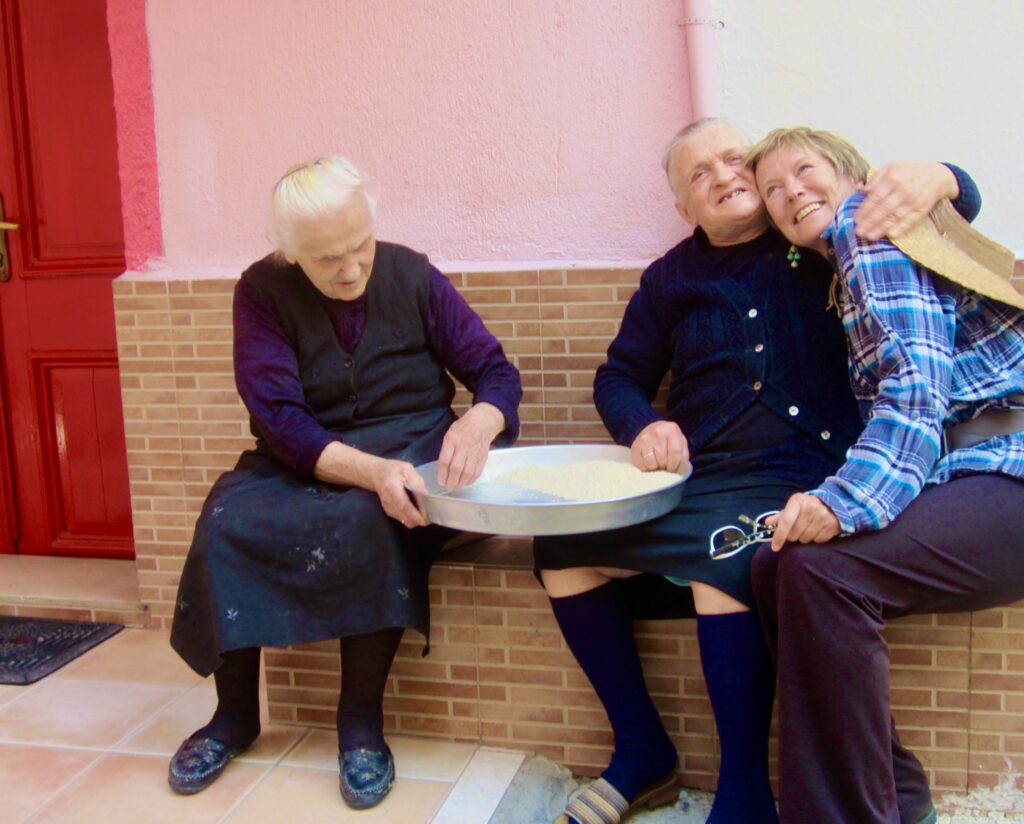
The Twerking Nun of Korçë
Albania 2013
story & photos by Lisa Alpine
It started off as a joke. A shared desire to go somewhere really mysterious and off-the-beaten-track with zero tourists—particularly Americans. Sitting in front of a crackling fire in Northern California, a glass of blood-red cabernet warming in our palms, we opened a National Geographic Atlas of the World in front of us. Dreamy-eyed, my partner Jordan and I turned the pages, traveling viscerally over the precarious mountain passes of Afghanistan, riding ponies across the Mongolian steppe, dragging our feet along the tundra, sailing a clipper ship to a sandspit in the Spice Islands.
Then, our fingers traced down the coast of Croatia, rippling around the stony islands clinging to the coastline of Montenegro, and bumped into Albania, perched above Greece on the Ionian Sea. It was a country whose borders I had skirted in 1972 while hitchhiking from Denmark to Greece. I remember that the young British man who had given me a ride in his Morgan Roadster along the length of the then-Yugoslavian coast shuddered when I mentioned that on the map, it looked like it would be a shorter route to Greece if we went through Albania. “No way,” he’d said. “That country is a poverty-stricken hellhole. Plus, we’d be jailed for even trying to enter.”
Jordan and I looked at each other. “Do you know anyone who’s been to Albania?”
“No. Do you?”
“No.”
“Let’s go!” We swigged our wine like pirates plotting a raid.
***
We quickly found there was a reason travelers didn’t go to Albania. It wasn’t on the radar. Or, as my British ride accentuated back in 1972, it was not just forbidden but dangerous. For 45 years, until 1991, the country was cut off from the outside world. First by Enver Hoxha, a paranoid dictator who didn’t let foreigners in or Albanians out. Then, by his successor, Ramiz Alia, the leader of the Communist Party. During this period, Albania was the most isolated and poorest country in Europe.
Not only is Albania off the radar for tourists, most people don’t know where it is. Even my travel-writer friends. Jordan and I chuckled how it got a rise out of them when we said—with a straight face—“We’re going to Albania. In two months.”
They would tilt their heads and look at us skeptically. “Where is that? Why Albania?” they’d ask.
“Because you don’t know where it is!” we would answer smugly, then we would laugh and laugh. Slap our thighs, wink at each other. Be obnoxiously elitist. In our minds, it was still a game we were playing that we’d actually go.
But the desire to explore somewhere untouched by Western civilization still dug into us. One morning, I read an obscure report from a German hiking club about the newly named Balkans Peace Trail—a meandering sheepherder and trader route that straddles the mountains between Albania, Kosovo, and Montenegro. It was the first time in a thousand years these borders were open. The hiking club’s vague description made it sound like it might even be marked with trail signs and that the Albanian Alps were deliciously unspoiled—like the Swiss Alps before the onslaught of the jet-set crowd. I didn’t know there were Alps in Albania. This country was becoming more enticing.
Suddenly it wasn’t a joke. Without much ado, we booked cheap flights on Lufthansa to Istanbul and then Turkish Airlines to Tirana, the capital of Albania. Done!
On a whim, I posted our upcoming adventure on Facebook and asked if anyone had travel tips or connections.
Expecting radio silence after the response from our traveling friends, I was surprised to get a note from a former writing student. She remembered that 20 years ago one of the members of her church went to volunteer at an orphanage in Albania and stayed there after meeting an irresistible missionary. Would I be interested in connecting with her? After my emphatic yes, my former student got in touch with her friend, and two days later I received an email from the missionary, whose name was Beth. She queried: “Would you like to come to Korçë and teach our kids to salsa dance?”
Where she got the salsa idea is a mystery. Perhaps she had visited my website and read that I teach dance, but the page clearly states that my expertise is in creative/modern/therapeutic. There’s not a word on there about salsa…
Still, who could resist such a wacky invitation?
Jordan and I salsa dance frequently—it was the glue that had sealed our union on the first date. So we knew what we were doing in some sense, but could we teach it? And would it be difficult to give dance step instructions in the Albanian language? Save the Children images paraded through my head. Perplexed, I contemplated the reality of teaching weak, malnourished orphans an energetic dance like salsa. We’d heard horror stories of recent conditions in orphanages in other autocratic dictatorships from Romania to Bulgaria.
On top of all this, our research had warned us about the perils of travel in Albania: gigantic ankle-twisting potholes, finger-busting gangsters, nothing to eat but 27 types of meatballs, no hot water, insane drivers, no English spoken.
But with the lure of hiking the Alps and giving dance instructions in the south, we threw our concerns to the wind and rhumbaed our way to the airport for our thirty-day adventure.
Our first night, we stayed at a youth hostel in Tirana and met our one and only American during the entire trip: a grizzly, disillusioned 80-year-old who complained he wasn’t going back to the United States until a black man was not our president. We avoided him like the vipers we were told to watch out for on the mountain trails.
Albania turned everything written about it on its ear. We encountered no thugs, no meatballs, and found plenty of hot water, safe drivers, and English spoken. Sure, there were a few potholes. And poisonous snakes, of which we’dseen four, including the deadly Ursini’s viper.
We hiked a portion of the Peace Trail, swam in the Ionian Sea, explored every UNESCO heritage site, discovered hot springs and ancient Ottoman bridges, drank stunning wines, and ate more food than we should have.
After three weeks, we circled around to Korçë in the southeast near the Greek border for our salsa gig. We settled into a dingy hotel, saw a gypsy with a dancing bear in the open market, and ate a yummy barbequed lamb lunch under a grape arbor. Then, dance shoes and iPod tucked into my purse, we wandered the narrow streets searching for the church that housed the orphanage.
The white plaster edifice topped with a bell tower took up the entire block. Its polished wooden doors were two stories tall and embedded with a giant brass knocker. Bang, bang, bang.
A short-haired, middle-aged woman dressed in jeans and a T-shirt pulled the door open. She was not the pale, stooped nun in a black habit and wimple I’d envisioned.
“Hi, I’m Beth,” she said in an American accent.
She shook our hands, turned, and briskly led us down a well-scrubbed tile corridor to a large meeting hall filled with 45 teenagers and a half-dozen Filipina nuns who lived in the convent at the nearby cathedral and ran the orphanage there. The building we entered turned out to not be an orphanage but an evangelical church safe house for abused girls and gypsy street kids, a day care center, a school, an elder care facility, and a youth activity center—all organized by our hosts.
I was expecting peasant garb and poverty, like something out of a Dickens novel, but the teens were good-looking and well-groomed, dressed in jeans and designer shirts. With eager smiles, they lined up like in a Zumba fitness class.
“No, no, no,” we said. “Come closer, circle around, and follow our feet.” We used lots of hand gestures to illustrate, as our Albanian was still at the please-and-thank-you stage. When I held up my iPod with a questioning look, a young man named Bujar plugged the device into an elaborate sound system on the stage.
Bright, bold Cuban salsa music burst into the hall and just like that, the kids were wiggling enthusiastically. I’d assumed they’d be shy, traditional, religious, needing pointers on how to move their hips and keep a beat. Oh no. They were already popping and grinding.
Jordan took the boys to one side and I circled up the girls. Since we didn’t really have a clue about the exact steps we were supposed to be teaching, we improvised, demonstrating our somewhat idiosyncratic version of salsa. Big smiles spread like sunshine across our faces. It seemed to be contagious: the teens happily partnered up and boogied around the floor with gusto.
Well-lubricated hips are a must for Cuban music, and getting those hips rotating was my job. Despite Jordan feeling miffed that I wasn’t following his lead, I suggested the girls do their own thing and not follow the guys. I know that’s not salsa but, hey, I’m from San Francisco and the era of freeform dancing in Golden Gate Park. Surprisingly, the nuns were on my side. They tittered and clapped their approval as I demonstrated the windy-windy—a sensuous figure-eight hip sway I learned on a bar top one New Year’s Eve in Honduras.
The big-boned European and American missionaries and tiny Filipina nuns hovering on the sidelines joined in. The nuns were really getting down, shedding their grey cardigans and shaking their hips. Then I saw something I never would have imagined. First, one of the younger nuns looked over at me and winked. Then, she slid her tweed skirt to right above her knees, slowly bent over, and twerked. It wasn’t an over-the-top Miley Cyrus gyration; it was a modest rendition, to be sure, but twerk she did.
The kids burst out laughing and suddenly, the playlist of Latin beats on the iPod and the twerking nun had launched an unexpected party.
What struck me most was that, unlike many Americans, these teens were unselfconscious and weren’t intimidated when asked to dance with new girls or boys—or even the nuns. Folk dancing is part of their home and social life, and as a result, they weren’t awkward or picky about who they danced with.
Two hours flew by in a frenzy of fancy footwork and lots of laughter, and all too soon the school bell rang, signaling the kids to go to algebra class. Bujar, the sound guy, copied my playlist onto his iPod so they could continue salsa dancing—or whatever Albanian hybrid it had morphed into during our short lesson with them.
The last teen reluctantly shuffled out. Our appetites stimulated by all the physical activity, Jordan and I invited Beth the missionary and her handsome husband Christopher to dinner, thinking they probably didn’t have the budget to dine out and could use a good meal. We, too, were up for a hearty repast because the next several days would consist of a long, bumpy, convoluted journey in Soviet-era busses across the Korab mountain range to Tirana and our flight home.
We asked them to choose the restaurant. Christopher pulled up in front of lavishly carved brass doors, which two men in well-cut Italian suits opened with a flourish as a valet parked Christopher’s jeep. Perfectly polished Mercedes’ and Humvees idled in line behind us. Christopher was greeted warmly with handshakes and invited with sweeping gestures to bring his entourage inside. Behind his back, Jordan and I raised a quick eyebrow over this seemingly well-connected missionary.
The foyer was decorated in hip Parisian-Moroccan palace-style. The maître d’ escorted us through fountained courtyards to a quiet table, where chill European lounge music and groovy pastel lighting set the tone. The waiter, who looked like Johnny Depp, handed Christopher a 12-page wine list with a bow.
Glancing around, we quickly realized we were the oldest people in the crowd. Where were we? This restaurant had unveiled an affluent Albania we’d not seen in our travels thus far.
“Where did all this wealth come from?” I asked Beth under my breath as Christopher ordered a pricey bottle of wine. She saw the look of concern in our eyes and assured us, “Don’t worry. They won’t charge us for the wine. Christopher is revered in this town. Just two years ago, the mayor and the town council voted unanimously to make him an ‘Honored Citizen of Korçë.’”
“What has he done to receive this honor?” Jordan asked.
Christopher’s face went red as a beet. “Let’s not talk about me,” he pleaded softly, shaking his head.
Beth’s eyes teared up as she told us his story anyway. “When he arrived in Korçë in 1991, right after the fall of the Communist dictator Alia, there was so much need—everything from distributing food to rescuing abused children. Christopher built all these social services from the ground up over the last twenty years and is now the Director of the Evangelical Church of Korçë.”
Still pondering this glitzy oasis in contrast to the horrors Beth just related, I asked, “But where does the money come from that built this rich neighborhood with designer stores and fancy restaurants?”
Beth took a quick look around before answering in a whisper, “Albanian gangsters living in Europe send money home to their families.”
This outpost of European swank housed several specialty bars and a disco, and served impeccable seafood and meats. I scanned the menu. Still no meatballs…
We spent half of our entire travel budget on dinner that night, but Christopher and Beth’s stories were worth it. Originally harkening from England, Christopher had been a missionary in Bulgaria and, now, Albania for a combined 40 years.
In between bites of carpaccio, walnut-stuffed figs, forest mushroom ragout, lamb and eggplant, crispy green-pepper salad, and a dozen other delicacies, we leaned forward to hear their shocking stories.
“Have you ever lived through a period of anarchy?” Christopher asked us in a conspiratorial tone, putting his fork down.
“Just a few violent coups, riots, and curfews in South America,” I responded.
“After Albania started getting back on its feet and opened its doors to the outside world in 1991, things went well for awhile. Then our economy collapsed in 1997 because of greedy pyramid schemes that sucked the life savings from hundreds of thousands of Albanians. A civil war broke out. All day and night we’d hear gunfire; it was complete anarchy. We had to protect the orphanage. Those little Filipina nuns you met back there were brave and staunch—they guarded the front doors holding Kalashnikovs. The guns were the same size as the nuns but those women were determined not to let the marauders near the children, afraid they’d kidnap or harm their young wards.”
“Where did the nuns get the AK-47’s?” I asked, trying to picture the grinning, twerking nun I’d met just hours ago hefting an assault rifle.
Christopher leaned forward and let out a heavy sigh. “Every police station and military outpost was abandoned. Citizens needed protection. They looted the gun lockers, munitions, and army depots, desperate to fight off the gangsters flooding in from the south. Every kid over the age of ten had at least one gun, and so did our nuns.”
After the waiter had refilled our wine glasses, Christopher continued, “This went on for over a year. Remember the photos of Albanians storming the docks and climbing up the anchor chains of Italian ferries and fishing vessels, trying to escape?”
I shook my head, recalling those images I’d indeed seen in the Los Angeles Times of thousands of desperate people scurrying over one another like ants, up the steel hulls and anchor chains of boats.
Christopher continued, “Now we’re in a peaceful time of prosperity and it’s thanks to remittances flowing in from Albanian refugees and gangsters in Europe and America. Two point seven million Albanians live here and three times that number are outside the country.”
The stories continued to pour forth—as did the expensive wine—till past midnight.
Jordan and I never would have imagined three months before, when we were tracing our fingers along the then-unfamiliar Balkan coastline, that our spontaneous desire for adventure would lead us to this remote edge of Albania. Who knew that we would witness a twerking nun, teach well-dressed orphans to dance, and eat in a gangster-funded glam restaurant?
Who knew that we would salsa and sup with heroic missionaries—saintly rock stars beloved by the community for protecting the children of their city through dangerous times? Now these missionaries welcome foreigners to teach their children, opening doors that were once closed, and bringing culture—and extemporaneous salsa—to Korçë.
Leave a Reply